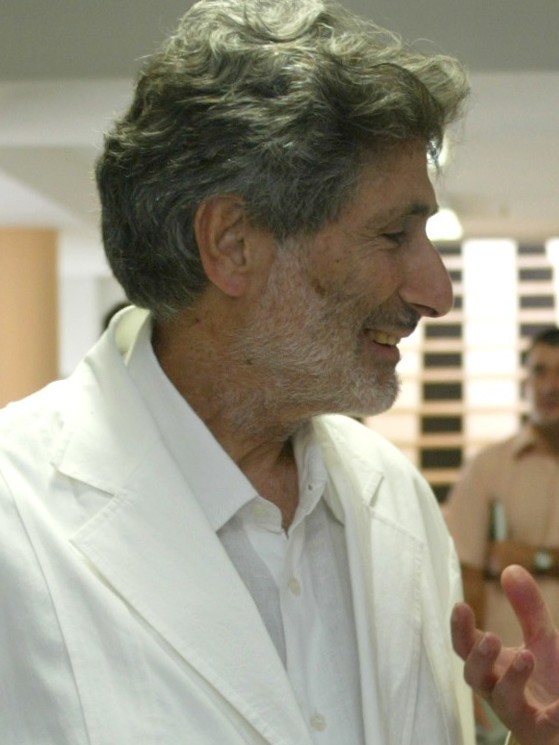
Edward Said

Edward Said was a prominent Palestinian-American scholar, literary critic, and activist, best known for his book 'Orientalism,' which critiqued Western perceptions of the East. His work has had a profound impact on postcolonial studies and discussions surrounding identity, representation, and the Palestinian experience.
Born on Sep 01, 1935 (91 years old)
Global Media Ratings
Countries Mentioned
| Country | Mentions | Sentiment | Dominance | + Persistence | x Population | = Reach | x GDP (millions) | = Power |
|---|---|---|---|---|---|---|---|---|
| United Kingdom | 1 | 5.00 | 0.12% | +0% | 67,886,011 | 78,300 | $2,700,000 | 3,114$ |
| Totals | 1 | 67,886,011 | 78,300 | $2,700,000 | 3,114$ |
Interactive World Map
Each country's color is based on "Mentions" from the table above.
Recent Mentions
 United Kingdom:
Edward Said predicted that the main threat Salman Rushdie faced would come from a random individual in the future.
5
United Kingdom:
Edward Said predicted that the main threat Salman Rushdie faced would come from a random individual in the future.
5
 Indonesia:
Edward Said is referenced as a postcolonial thinker who critiques the hierarchy of 'developed-underdeveloped'.
5
Indonesia:
Edward Said is referenced as a postcolonial thinker who critiques the hierarchy of 'developed-underdeveloped'.
5
 Tunisia:
Edward Said identified the mechanism of orientalism that constructs the East as an object of description.
7
Tunisia:
Edward Said identified the mechanism of orientalism that constructs the East as an object of description.
7
 Taiwan:
Edward Said is mentioned as a Palestinian academic who defined the concept of an intellectual in relation to Lam Wing-kei.
5
Taiwan:
Edward Said is mentioned as a Palestinian academic who defined the concept of an intellectual in relation to Lam Wing-kei.
5
United Kingdom:
The conservatory is named after Edward Said, the Palestinian-US scholar and activist.
8
 Norway:
Edward Said is cited in relation to the duo Karpe, emphasizing the diversity of Muslim experiences and interpretations of Islam.
7
Norway:
Edward Said is cited in relation to the duo Karpe, emphasizing the diversity of Muslim experiences and interpretations of Islam.
7
 Iraq:
Edward Said notes that Naguib Mahfouz's works are renowned not only for their longevity but also for their unique perspective on Middle Eastern society.
8
Iraq:
Edward Said notes that Naguib Mahfouz's works are renowned not only for their longevity but also for their unique perspective on Middle Eastern society.
8
 Switzerland:
Edward Said is mentioned as a prominent intellectual who criticized observers of the Iranian regime.
5
Switzerland:
Edward Said is mentioned as a prominent intellectual who criticized observers of the Iranian regime.
5
 South Africa:
Edward Said famously referred to this dynamic in his work Orientalism.
6
South Africa:
Edward Said famously referred to this dynamic in his work Orientalism.
6
 Bangladesh:
Edward Said's work on Orientalism is referenced as a critique of Tom Barrack's views.
8
Bangladesh:
Edward Said's work on Orientalism is referenced as a critique of Tom Barrack's views.
8