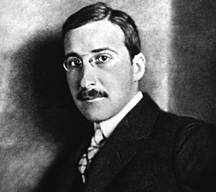
Stefan Zweig

Stefan Zweig was an Austrian novelist and biographer, known for his psychological insight and deep understanding of human emotions, exemplified in works like 'The World of Yesterday'. His writings often reflect the cultural upheaval of early 20th-century Europe.
Born on Nov 28, 1881 (144 years old)
Global Media Ratings
Countries Mentioned
| Country | Mentions | Sentiment | Dominance | + Persistence | x Population | = Reach | x GDP (millions) | = Power |
|---|---|---|---|---|---|---|---|---|
| Switzerland | 1 | 8.00 | 0.21% | +0% | 8,654,622 | 18,532 | $700,000 | 1,499$ |
| Italy | 1 | 7.00 | 0.21% | +0% | 60,461,826 | 128,642 | $2,000,000 | 4,255$ |
| Totals | 2 | 69,116,448 | 147,174 | $2,700,000 | 5,754$ |
Interactive World Map
Each country's color is based on "Mentions" from the table above.
Recent Mentions
 Italy:
Stefan Zweig wrote about the uncertainty of life without rights and security.
7
Italy:
Stefan Zweig wrote about the uncertainty of life without rights and security.
7
 Switzerland:
Stefan Zweig lived in Salzburg for fifteen years and was a meeting point for international artists.
8
Switzerland:
Stefan Zweig lived in Salzburg for fifteen years and was a meeting point for international artists.
8
 Greece:
Stefan Zweig is referenced in relation to the experiences of different generations observing the past.
6
Greece:
Stefan Zweig is referenced in relation to the experiences of different generations observing the past.
6
Switzerland:
Stefan Zweig was a prominent writer who hosted many intellectuals and artists at his villa in Salzburg.
9
Italy:
Stefan Zweig lived in the villa and wrote part of his works there before leaving Austria in 1934.
9
 Costa Rica:
Stefan Zweig committed suicide in 1942 in Brazil due to the despair of losing his homeland and hope.
5
Costa Rica:
Stefan Zweig committed suicide in 1942 in Brazil due to the despair of losing his homeland and hope.
5
 France:
Stefan Zweig is noted for having praised the work of Emile Verhaeren.
8
France:
Stefan Zweig is noted for having praised the work of Emile Verhaeren.
8
 Germany:
Stefan Zweig wrote the famous 'Schachnovelle' in 1942 while in exile in Brazil.
8
Germany:
Stefan Zweig wrote the famous 'Schachnovelle' in 1942 while in exile in Brazil.
8
 Slovenia:
Stefan Zweig fled Austria before World War II and found refuge in Brazil.
6
Slovenia:
Stefan Zweig fled Austria before World War II and found refuge in Brazil.
6
Germany:
Stefan Zweig described the hesitation of Marshal Grouchy during a critical moment in history.
7