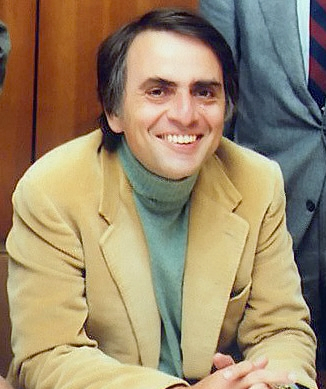
Carl Sagan

Carl Sagan was an American astronomer, cosmologist, author, and science communicator, renowned for his ability to popularize complex scientific concepts. He played a pivotal role in the search for extraterrestrial life and was instrumental in the planning of several NASA missions, including the Viking landers on Mars. Sagan authored numerous books, including the best-selling 'Cosmos,' which accompanied a television series of the same name, bringing science to the general public in an accessible and engaging manner. His work emphasized the importance of critical thinking and the scientific method, and he advocated for environmental protection and nuclear disarmament.
Born on Nov 09, 1934 (92 years old)
Global Media Ratings
Countries Mentioned
No country-level mention data available.
Interactive World Map
Each country's color is based on "Mentions" from the table above.
Recent Mentions
 Greece:
Carl Sagan was the sweet-talking astronomy professor from Cornell University who was responsible for designing the message to be sent into space.
9
 India:
Carl Sagan, the celebrated astronomer, author and science communicator, helped millions of people understand the universe through his books, lectures and television programmes.
9
 Uruguay:
Carl Sagan warned the United States Congress about the impending problems due to greenhouse gas emissions.
8
 Guatemala:
Carl Sagan is referenced for his views on science as a path for developing nations.
9
 Mexico:
Carl Sagan suggested that the intensity of passion during the World Cup is almost genetic.
8
 United States:
Carl Sagan proposed a revision of the Kardashev scale in the 1970s to add more subtlety.
8
 Serbia:
Carl Sagan proposed the idea that Earth is a 'pale blue dot' representing every person who has ever lived.
9
 Panama:
Carl Sagan's writings inspired many to reflect on the insignificance of Earth in the vastness of the universe.
8
 Israel:
Carl Sagan harshly criticized von Däniken's work, labeling it as pseudoscience and indicative of careless thinking.
2
 Denmark:
Carl Sagan named the iconic image of Earth taken by Voyager 1 as 'Pale Blue Dot'.
9