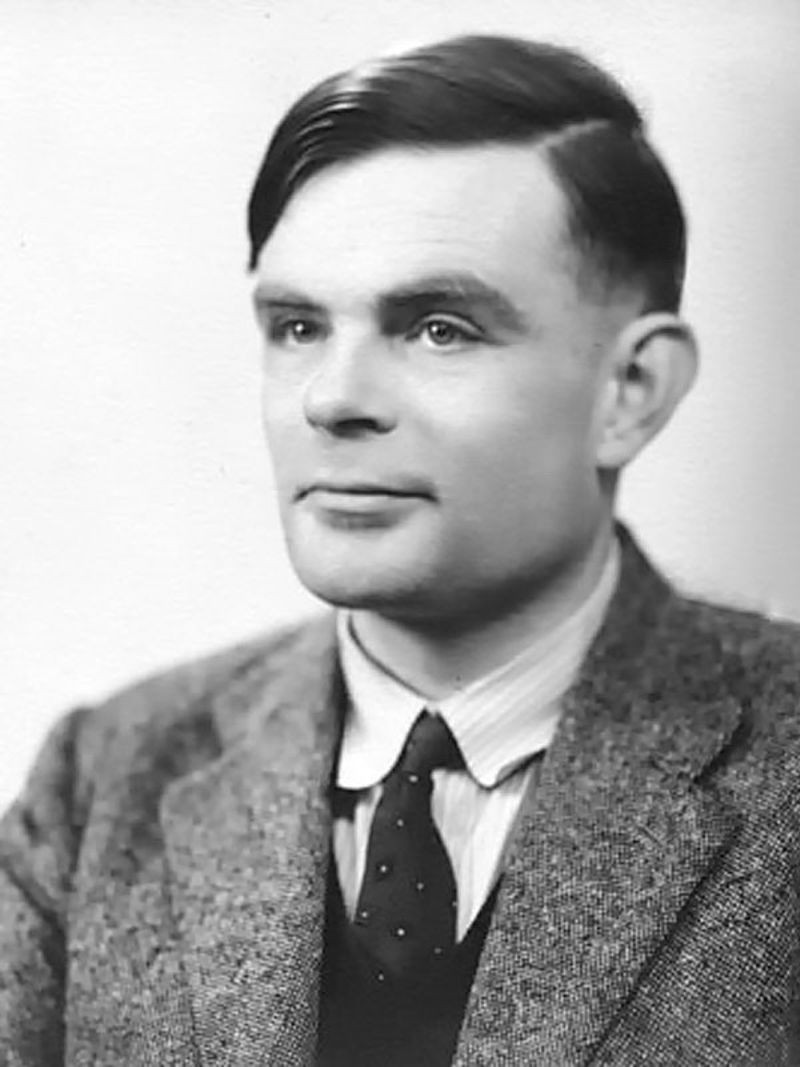
Alan Turing

Alan Turing was a pioneering British mathematician, logician, and computer scientist, widely considered to be the father of computer science and artificial intelligence. His work during World War II on breaking the German Enigma code was critical to the Allied victory, and his legacy continues to influence modern computing and cryptography.
Born on Jun 23, 1912 (114 years old)
Global Media Ratings
Countries Mentioned
| Country | Mentions | Sentiment | Dominance | + Persistence | x Population | = Reach | x GDP (millions) | = Power |
|---|---|---|---|---|---|---|---|---|
| Guatemala | 1 | 5.00 | 0.23% | +0% | 17,915,568 | 41,471 | $82,000 | 190$ |
| Panama | 1 | 6.00 | 0.26% | +0% | 4,314,768 | 11,266 | $76,000 | 198$ |
| Argentina | 1 | 9.00 | 0.21% | +0% | 45,195,774 | 96,161 | $450,000 | 957$ |
| Totals | 3 | 67,426,110 | 148,898 | $608,000 | 1,345$ |
Interactive World Map
Each country's color is based on "Mentions" from the table above.
Recent Mentions
 Guatemala:
Turing wrote in the 1950s that if intelligent machines became possible, they could take control.
5
Guatemala:
Turing wrote in the 1950s that if intelligent machines became possible, they could take control.
5
 Argentina:
Alan Turing is recognized for his visionary intuition regarding intelligent machines.
9
Argentina:
Alan Turing is recognized for his visionary intuition regarding intelligent machines.
9
 Panama:
Alan Turing wrote in the 1950s that if intelligent machines became possible, they could take control.
6
Panama:
Alan Turing wrote in the 1950s that if intelligent machines became possible, they could take control.
6
 Uruguay:
Alan Turing is considered the father of computing and formulated the question of whether machines can think.
9
Uruguay:
Alan Turing is considered the father of computing and formulated the question of whether machines can think.
9
 Germany:
Alan Turing was Britain's most significant codebreaker during World War II.
7
Germany:
Alan Turing was Britain's most significant codebreaker during World War II.
7
 Paraguay:
Alan Turing was a key scientist in the development of artificial intelligence and the deciphering of codes during World War II.
9
Paraguay:
Alan Turing was a key scientist in the development of artificial intelligence and the deciphering of codes during World War II.
9
 United Kingdom:
Alan Turing is remembered as the father of modern computing and a prominent code breaker during World War II.
9
United Kingdom:
Alan Turing is remembered as the father of modern computing and a prominent code breaker during World War II.
9
 Belarus:
Alan Turing is mentioned as a historical figure whose image may be replaced on banknotes.
5
Belarus:
Alan Turing is mentioned as a historical figure whose image may be replaced on banknotes.
5
 Ukraine:
The image of mathematician Alan Turing on banknotes will eventually be replaced by portraits of animals.
5
Ukraine:
The image of mathematician Alan Turing on banknotes will eventually be replaced by portraits of animals.
5
 Hungary:
Alan Turing proposed the Turing test in 1950 to determine if a machine can exhibit intelligent behavior equivalent to that of a human.
9
Hungary:
Alan Turing proposed the Turing test in 1950 to determine if a machine can exhibit intelligent behavior equivalent to that of a human.
9