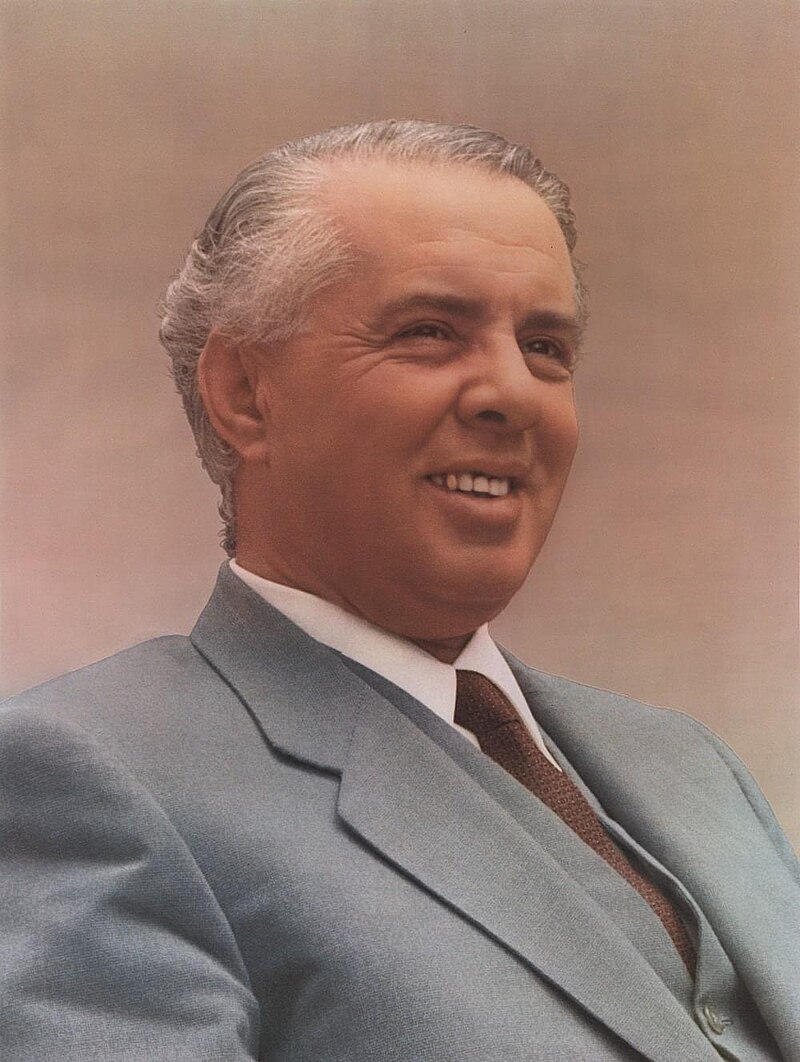
Enver Hoxha

Enver Hoxha was the communist leader of Albania, ruling from the end of World War II until his death in 1985. His regime is known for its strict authoritarianism, isolationist policies, and significant human rights abuses. Hoxha's influence remains a controversial aspect of Albanian history, particularly in his birthplace of Gjirokastër, which is noted for its well-preserved Ottoman architecture and historical significance.
Born on Apr 16, 1908 (118 years old)
Global Media Ratings
Countries Mentioned
| Country | Mentions | Sentiment | Dominance | + Persistence | x Population | = Reach | x GDP (millions) | = Power |
|---|---|---|---|---|---|---|---|---|
| Ukraine | 1 | 3.00 | 0.21% | +0% | 43,733,762 | 93,648 | $155,000 | 332$ |
| Totals | 1 | 43,733,762 | 93,648 | $155,000 | 332$ |
Interactive World Map
Each country's color is based on "Mentions" from the table above.
Recent Mentions
 Ukraine:
Enver Hoxha was an Albanian communist leader known for his totalitarian regime and extensive military expenditures.
3
Ukraine:
Enver Hoxha was an Albanian communist leader known for his totalitarian regime and extensive military expenditures.
3
 United Kingdom:
In Tirana, Albania, is a bizarre glass pyramid that the tyrant Enver Hoxha constructed as a museum about his life.
2
United Kingdom:
In Tirana, Albania, is a bizarre glass pyramid that the tyrant Enver Hoxha constructed as a museum about his life.
2
 Romania:
Enver Hoxha was the communist leader of Albania whose regime was targeted by Western intelligence operations.
3
Romania:
Enver Hoxha was the communist leader of Albania whose regime was targeted by Western intelligence operations.
3
 Montenegro:
Enver Hoxha was a notorious communist dictator in Albania during whose regime Fatos Lubonja was imprisoned.
1
Montenegro:
Enver Hoxha was a notorious communist dictator in Albania during whose regime Fatos Lubonja was imprisoned.
1
 North Macedonia:
Enver Hoxha was a long-time communist dictator whose statue's fall is symbolically referenced during the protests.
2
North Macedonia:
Enver Hoxha was a long-time communist dictator whose statue's fall is symbolically referenced during the protests.
2
 Norway:
Enver Hoxha was the leader of Albania during the harsh communist regime that affected Lea Ypi's upbringing.
2
Norway:
Enver Hoxha was the leader of Albania during the harsh communist regime that affected Lea Ypi's upbringing.
2
 Denmark:
Enver Hoxha ruled Albania with an iron fist from 1944 to 1991.
3
Denmark:
Enver Hoxha ruled Albania with an iron fist from 1944 to 1991.
3
 Uruguay:
Enver Hoxha was the tyrannical leader of Albania during the Stalinist regime.
2
Uruguay:
Enver Hoxha was the tyrannical leader of Albania during the Stalinist regime.
2
Montenegro:
Enver Hoxha's Stalinist era traumas are cited as a reason for Albania's reluctance to turn towards Russia.
5
 Serbia:
During Enver Hoxha's communist rule, Berat was known as a political center for internment of regime opponents and their families.
5
Serbia:
During Enver Hoxha's communist rule, Berat was known as a political center for internment of regime opponents and their families.
5