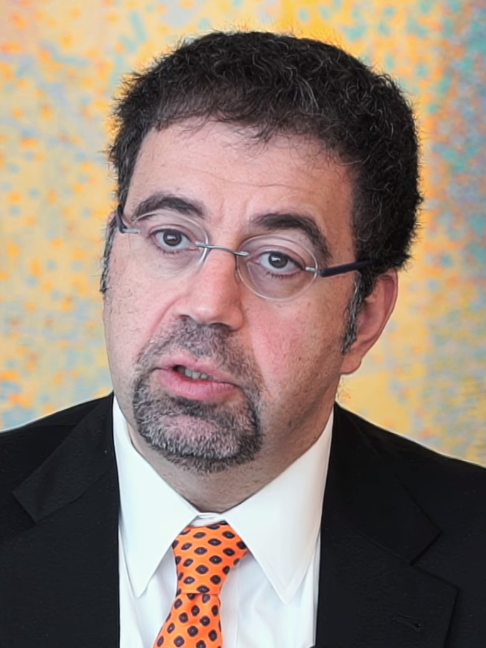
Daron Acemoglu

Daron Acemoglu is a prominent economist known for his extensive research on the factors that lead to economic disparities among nations. Born in Istanbul to Armenian parents, he has made significant contributions to the understanding of political economy and institutional economics. He co-authored the influential books 'Why Nations Fail' and 'The Narrow Corridor,' which explore the relationship between institutions, economy, and society. A professor at the Massachusetts Institute of Technology (MIT) since 1993, Acemoglu was awarded the Nobel Prize in Economic Sciences in 2024. Recently, he has been in the news for warning about the decline of trust in Western democracies and the growing polarization exacerbated by social media.
Born on Sep 03, 1967 (59 years old)
Global Media Ratings
Countries Mentioned
No country-level mention data available.
Interactive World Map
Each country's color is based on "Mentions" from the table above.
Recent Mentions
 India:
Daron Acemoglu issued a public challenge to Elon Musk regarding his wealth and philanthropy.
7
India:
Daron Acemoglu issued a public challenge to Elon Musk regarding his wealth and philanthropy.
7
 United Kingdom:
Daron Acemoglu, the Nobel prize-winning economist, noted that insiders still believe artificial general intelligence is around the corner.
6
United Kingdom:
Daron Acemoglu, the Nobel prize-winning economist, noted that insiders still believe artificial general intelligence is around the corner.
6
 Indonesia:
Daron Acemoglu's work is cited regarding the factors that contribute to the success or failure of nations.
6
Indonesia:
Daron Acemoglu's work is cited regarding the factors that contribute to the success or failure of nations.
6
 Belarus:
Daron Acemoglu is a Nobel Prize-winning economist who offers a different interpretation of declining birth rates.
8
Belarus:
Daron Acemoglu is a Nobel Prize-winning economist who offers a different interpretation of declining birth rates.
8
 Switzerland:
Daron Acemoglu is an MIT professor and Nobel laureate who previously published a paper skeptical of the AI hype.
6
Switzerland:
Daron Acemoglu is an MIT professor and Nobel laureate who previously published a paper skeptical of the AI hype.
6
 Costa Rica:
Daron Acemoglu warns that automation can replace certain tasks and increase inequalities if economies do not adapt.
5
Costa Rica:
Daron Acemoglu warns that automation can replace certain tasks and increase inequalities if economies do not adapt.
5
Indonesia:
Daron Acemoglu is one of the authors of the book 'Why Nations Fail'.
8
Switzerland:
Daron Acemoglu is a Nobel Prize-winning economist and a professor at MIT.
9
 Peru:
Daron Acemoglu's concept of inclusive economic institutions is referenced in the context of reducing poverty.
5
Peru:
Daron Acemoglu's concept of inclusive economic institutions is referenced in the context of reducing poverty.
5
Indonesia:
Daron Acemoglu and James Robinson stated that sustainable economic development requires inclusive institutions, not just an active state.
7