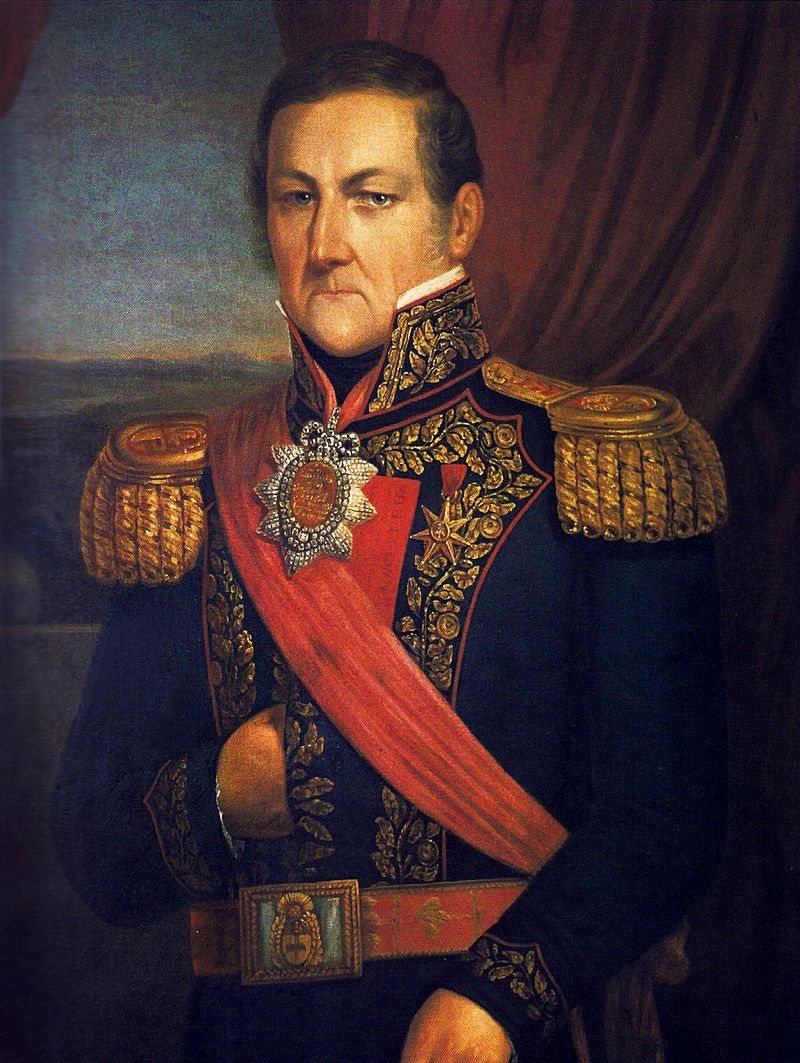
Juan Manuel de Rosas

Juan Manuel de Rosas was a dominant Argentine political figure and military leader who served as governor of Buenos Aires Province during two periods in the 19th century. A key ally of Facundo Quiroga, Rosas was a staunch federalist who centralized power and implemented policies that favored the rural elite. His authoritarian rule was marked by significant repression of opposition, leading to a complex legacy in Argentine history.
Born on Mar 30, 1793 (233 years old)
Global Media Ratings
Countries Mentioned
| Country | Mentions | Sentiment | Dominance | + Persistence | x Population | = Reach | x GDP (millions) | = Power |
|---|---|---|---|---|---|---|---|---|
| Argentina | 1 | 5.00 | 0.19% | +0% | 45,195,774 | 83,696 | $450,000 | 833$ |
| Uruguay | 1 | 5.00 | 0.19% | +0% | 3,473,730 | 6,693 | $54,000 | 104$ |
| Totals | 2 | 48,669,504 | 90,389 | $504,000 | 937$ |
Interactive World Map
Each country's color is based on "Mentions" from the table above.
Recent Mentions
 Uruguay:
Juan Manuel de Rosas was involved in the last meeting with Facundo Quiroga in Azcuénaga.
5
Uruguay:
Juan Manuel de Rosas was involved in the last meeting with Facundo Quiroga in Azcuénaga.
5
 Argentina:
Rosas was a key figure in the debates between unitarios and federales during the Argentine political conflicts.
5
Argentina:
Rosas was a key figure in the debates between unitarios and federales during the Argentine political conflicts.
5
Argentina:
The decision regarding the Sable Corvo involved claims from descendants of Juan Manuel de Rosas.
5
Argentina:
Juan Manuel de Rosas is noted as the person to whom San Martín bequeathed the treasure by testament.
5
Argentina:
Juan Manuel de Rosas was the recipient of the saber as per San Martín's will.
6
Argentina:
The building housing the Monumentos y Obras de Arte was once inhabited by the domestic staff of governor Juan Manuel de Rosas.
5
Argentina:
Juan Manuel de Rosas was the husband of María Josefa Ezcurra and a notable political figure in Argentina.
3
Argentina:
Juan Manuel de Rosas was the governor of Buenos Aires and played a key role in the defense against foreign powers during the Battle of Vuelta de Obligado.
8
Argentina:
Juan Manuel de Rosas governed the country during the time of the Battle of the Vuelta de Obligado.
7
Argentina:
Juan Manuel de Rosas was the governor during José Hernández's youth, influencing his connection to rural life.
5